

This article is for general informational purposes. Always follow your surgeon's specific post-operative instructions when choosing recovery garments.
If you have surgery scheduled, you have probably already thought about the big questions: which surgeon, which procedure, which day. The closure on your post-surgical bra may not be on that list yet. It should be. In the days and weeks after chest, breast, or upper-body surgery, the way a bra opens and closes can affect your comfort every single time you get dressed, use the bathroom, or check a drain.
Choosing the right closure before surgery — rather than deciding afterward, with limited mobility and a healing incision — is one of the more practical steps you can take during pre-surgery preparation. Most pre-surgery checklists focus on medication schedules, meal prep, and arranging help at home. Garment planning tends to be left until the last few days before surgery, if it is planned for at all, which often means the closure decision gets made quickly at a pharmacy or a hospital gift shop rather than researched in advance.
Taking even fifteen minutes before surgery to understand your closure options can prevent a difficult first week. This guide walks through the three closure types you will most commonly see in post-surgical and compression bras, how each one works, and which situations tend to favor one over another, so you can make this decision in advance rather than during recovery.
Why Closure Type Matters After Surgery
Most people do not think about how a bra closes until they cannot manage the one they already own. After chest or breast surgery, several common limitations change what "easy to close" actually means:
Limited shoulder and arm mobility. Reaching behind your back, a motion most closures rely on, is often restricted or painful for days to weeks after surgery.
Swelling that changes size day to day. A closure that fit comfortably in the morning may feel tight by evening.
Surgical drains. Some recoveries involve drains that need to be accessed multiple times a day without fully removing the garment.
Sensitive incision sites. Closures positioned near an incision, or that require pulling fabric across one, can cause unnecessary discomfort.
Reduced fine motor control if you are managing pain medication. Small clasps or fiddly fasteners become genuinely difficult to manage.
Because these limitations are common but not universal, no single closure type is correct for everyone. The right choice depends on your specific procedure, your recovery timeline, and how much help you will have getting dressed in the first week or two.
It is also worth considering how often you will need to open and close the bra in a single day. A garment you put on once each morning has different requirements than one you may need to open several times daily for drain checks, wound care, or simply because comfort levels change throughout the day. Frequency of use is easy to overlook when comparing bras online, but it becomes very noticeable during the first week of actual recovery.
Comparing the Three Bra Closure Types

Velcro Closures
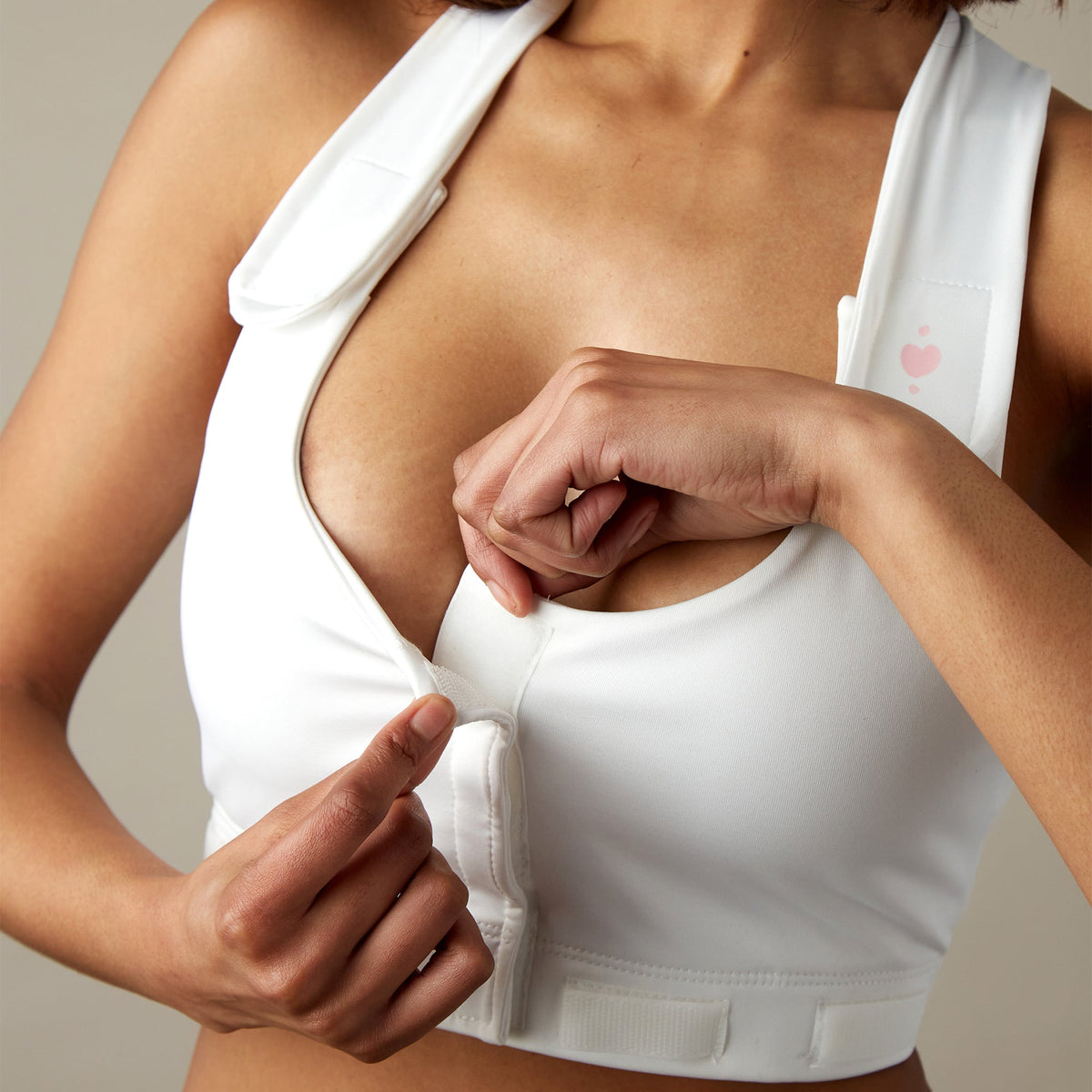
Velcro is one of the most widely used closures in post-surgical bras. A soft loop material pairs with a firmer hook strip, allowing the closure to be pulled open and pressed shut with one hand and very little grip strength.
How it works: The two strips overlap and press together. There is no need to align small components or apply repeated pressure at a single point.
Where it tends to work well:
-
Recoveries involving limited hand strength or coordination
-
Situations where a caregiver is helping with dressing, since the closure is simple to guide even without practice
-
Recoveries where daily size adjustment matters, since medical-grade Velcro can typically be repositioned across a small range without needing a different size garment
-
Front-closure designs, where reaching behind the back is not required at all
Considerations:
-
Quality matters significantly. Medical-grade Velcro is engineered to be soft against healing skin and to hold securely without excessive scratchiness; lower-quality versions can catch on fabric or irritate skin with repeated use.
-
Over time and repeated washing, hook-and-loop closures can lose some holding strength, so garment care instructions should be followed closely.
-
Because the closure can be adjusted across a range rather than fixed at set points, it tends to accommodate gradual swelling reduction well over the first several weeks, without needing the band tightened at fixed intervals. This is the same adjustability built into heart&core's Larissa and Serena bras.
Velcro closures are also common in bras that manage surgical drains, since the wide, flat closure area can be positioned to work alongside drain tabs without adding bulk near the incision site. heart&core's Larissa Post-Surgical Bra and Serena Post-Surgical Bra both use medical-grade Velcro closures for this reason. The Larissa is built around Prody™ Drainage Bulb Holder tabs specifically, giving it a wide, flat band designed to keep drains positioned securely, while the Serena is built for use through the post-drain phase of recovery, once drains have been removed but consistent compression is still needed.

Shop Larissa

Shop Serena

Zipper Closures
A zipper closure runs a single track, typically down the front or side of the bra, and is operated with one continuous motion rather than repeated pressing or hooking.
How it works: A zipper pull is drawn along a fixed track, gradually opening or closing the garment. Unlike Velcro, it does not require aligning two separate pieces, and unlike smaller fastening systems, it does not depend on precise finger placement.
Where it tends to work well:
-
Recoveries where a single, controlled motion is easier than repeated adjustments
-
Larger or more significant swelling fluctuations across the day, when paired with a design built for it, since a well-constructed zipper track can accommodate more size range than a fixed-length closure
-
Situations where speed and simplicity matter, such as needing to change quickly for a shower or a drain check
-
Bras with a double-zipper construction, which offer a wider range of adjustment than a single-track zipper
heart&core's Shirl Post-Surgical Bra is built around this approach, using a double-zipper closure specifically to accommodate size fluctuation and limited mobility during recovery. Because weight and swelling changes are common in the weeks after surgery, a double-zipper design gives more room to adjust without requiring a full garment change, which is part of why it is a useful option for recoveries where body size is expected to shift. Both the Larissa and Serena use the same 95% nylon/5% spandex fabric blend as the Shirl, so the choice between them typically comes down to closure preference and drain needs rather than fabric performance.

Shop Shirl
Considerations:
-
A zipper needs to be aligned correctly at the start of the track, which can take a moment of practice.
-
Zipper pulls should sit away from the skin or incision site to avoid irritation, so garment construction matters here as much as the closure itself.
-
A larger pull tab, sometimes with a fabric loop or ring attached, makes the zipper easier to manage for anyone with reduced grip strength or numbness in the fingers, which can occur temporarily after some procedures.
A double-zipper construction, specifically, addresses a limitation of a single-track zipper: with only one zipper, the entire closure typically needs to be opened from one end, even for a small adjustment. A second zipper track allows the garment to be opened from either direction, so a small adjustment near the top does not require undoing the entire closure. This becomes particularly relevant when weight fluctuates during recovery, since it allows the bra to flex across a wider range without the fit becoming uneven at one end.

Hook-and-Eye Closures
Hook-and-eye is a traditional bra closure found on many everyday and shapewear bras, consisting of a row of small metal or plastic hooks that catch onto corresponding eyes or loops, usually at the back of the garment.
How it works: Each hook is manually aligned with its matching eye, one at a time, and the process is typically repeated across two or three rows to adjust the band size.
Where it tends to work well:
-
Everyday bras where fine motor control and full shoulder mobility are not a concern
-
Situations where a very precise, incremental size adjustment is useful, since multiple rows allow small changes in band tightness
Considerations for post-surgical use:
-
This closure typically requires reaching behind the back and aligning small components with both hands, which is difficult during the early recovery window when shoulder mobility is limited.
-
The repeated pressure needed to fasten multiple hooks can be uncomfortable when reaching or twisting motions are restricted.
-
Hooks sit at a fixed set of positions rather than adjusting smoothly, which offers less flexibility for day-to-day swelling changes than Velcro or a well-designed zipper.
For these reasons, hook-and-eye is far more common in standard, non-surgical bras than in garments designed specifically for post-surgical recovery.
What to Look for Beyond the Closure
The closure type is one important decision, but it works alongside several other features that affect comfort and function during recovery.
Fabric and Construction
Fabric blend: A high-quality blend such as 95% nylon and 5% spandex provides consistent, even compression without losing its shape after repeated wear and washing.
Breathable, moisture-wicking material: Healing skin benefits from staying dry, and breathable fabric helps prevent irritation around incisions and drain sites during extended wear.
No underwire: Post-surgical bras are built without the rigid underwire structure found in standard bras. Underwire creates a fixed pressure point directly across the chest, which can interfere with healing tissue and incision sites, so its absence is a deliberate design choice rather than an oversight. This holds true across heart&core's Larissa, Serena, and Shirl bras alike.
Seam placement: Flat or minimal seams reduce friction against sensitive skin, particularly in areas where an incision or drain site is located. Seams positioned away from these areas make a noticeable difference over weeks of daily wear.
Fabric quality also affects how a garment behaves alongside whichever closure type you choose. A blend with enough structure to hold its shape supports the closure in maintaining even pressure, while a fabric that stretches out of shape too easily can undermine the benefit of even a well-designed zipper or Velcro system.
Straps
Wide, adjustable straps distribute weight across a broader area of the shoulder rather than concentrating it in a narrow band. This matters more than it might seem: after chest or breast surgery, shoulder and chest tissue can be sensitive, and a strap that digs in adds discomfort on top of an already healing area. Adjustability also allows the strap length to change as swelling changes, without needing a different bra. heart&core builds this wide, adjustable strap design into the Larissa, Serena, and Shirl.
Cushioned strap padding is a small feature that becomes more noticeable during extended wear. Because post-surgical bras are often worn most of the day, and sometimes overnight, straps that felt fine for a few hours of regular use can become uncomfortable across a full day of continuous wear. Padding distributed along the strap, rather than only at the point where it meets the shoulder, tends to hold up better over long wear periods.
Room for Swelling and Size Fluctuation
Swelling rarely follows a straight line during recovery. It is often at its highest in the first several days, gradually decreases over the following weeks, and can still fluctuate with activity or time of day even after the initial healing period. A bra that only fits one size accurately will not hold up well through those changes, which is why closure type and adjustability directly affect each other.
FSA/HSA Eligibility
Post-surgical bras are frequently eligible for purchase using FSA or HSA funds, since they are considered medical recovery garments rather than standard apparel. heart&core's post-surgical bras, including the Larissa, Serena, and Shirl, are all FSA/HSA approved through IIAS certification via sig-is.org, regardless of which closure type is chosen. This makes closure selection a matter of fit and function rather than a trade-off against eligible reimbursement, which can make the decision more accessible for patients managing multiple recovery-related expenses.
Matching Closure Type to Your Procedure
Different procedures come with different mobility restrictions and different expected size changes, which means the closure that works well for one recovery is not always the best fit for another. These are general patterns rather than fixed rules, and your surgeon's specific guidance should always take priority.
Breast or chest surgery involving lymph node removal
When lymph nodes are removed, arm and shoulder mobility on the affected side is often restricted for a period after surgery, and reaching behind the back may not be advisable at all in the early days. A front-closing design, whether Velcro or zipper, removes this motion from the equation entirely. heart&core's Larissa Bra, with its front Velcro closure, is often suited to this stage of recovery.
Procedures involving surgical drains
Recoveries that involve drains benefit from a closure that allows repeated, partial access throughout the day without needing to remove the entire garment. Both Velcro and zipper closures can be paired with dedicated drain management features, such as built-in tabs, that keep drains secure and easy to reach — the Larissa Bra is built specifically around this need.
Procedures with expected weight or volume changes
Some recoveries involve more significant changes in chest size or overall body weight during the healing window, whether from the procedure itself, temporary fluid retention, or broader lifestyle changes during recovery. In these cases, a closure built for a wider adjustment range, such as a double-zipper design, tends to hold up better over time than a closure with a narrower fit window. heart&core's Shirl Bra was built specifically for this kind of fluctuation and is a common fit here.
Shorter recoveries with minimal mobility restriction
For procedures with a brief recovery period and little restriction on arm movement, the closure decision carries somewhat less weight, since more closure types remain realistically manageable. Even so, many patients still prefer a front closure simply for convenience during the first several days. heart&core's Serena Bra, with its simpler Velcro closure, tends to suit this kind of shorter recovery well.
How to Decide: A Simple Framework
If you are trying to choose ahead of surgery, these questions can help narrow the decision:
Will you have full use of both arms in the first week?
If mobility will be limited, a front-closing Velcro or zipper design is generally easier to manage independently than anything requiring reach-behind fastening.
Do you expect significant swelling or weight-related size changes?
If so, a double-zipper design, like the one used in the Shirl bra, offers a wider adjustment range than a fixed closure.
Will someone be helping you dress in the early days?
Velcro is often the simplest closure for a caregiver to manage, since it does not require precise alignment.
Do you have surgical drains?
Look for a closure and overall design that allows drain access without requiring the bra to be fully removed or repositioned.
How long is your expected recovery window?
Longer recoveries with more size fluctuation tend to benefit from closures built for a wider adjustment range, rather than closures optimized for a single, stable fit.
There is no single right answer for every recovery. The goal is matching the closure to your specific mobility, swelling pattern, and daily routine during the weeks that matter most.
FAQ: Post-Surgical Bra Closures
Is Velcro or zipper better after surgery?
Both are generally easier to manage than closures requiring reach-behind fastening. Velcro tends to suit recoveries where simplicity and one-handed operation matter most, while a zipper, particularly a double-zipper design, tends to suit recoveries with more significant swelling or size changes.
Why don't post-surgical bras have underwire?
Underwire is built for stable, healthy tissue, and it holds its shape by pressing firmly against the ribcage and chest wall. That fixed pressure is exactly what healing tissue does not need in the weeks after surgery, which is why post-surgical bras rely on the fabric blend and band construction for support and shape instead.
Can I adjust a post-surgical bra as my swelling changes?
Yes, in most well-designed post-surgical bras. Wide, adjustable straps and a closure built for a range of sizes, such as the double-zipper design of the Shirl Bra, both help accommodate daily and weekly changes in swelling.
Will my insurance or FSA/HSA cover a post-surgical bra?
heart&core's entire collection of post-surgical bras are FSA/HSA eligible through IIAS certification. Check your specific plan for confirmation, since coverage details vary.
How many post-surgical bras will I need during recovery?
Most patients benefit from having at least two, so one can be worn while the other is washed, ensuring continuous support throughout the healing period.
Can I choose a closure type before I know how limited my mobility will be?
Yes. If you are unsure how limited your mobility will be, front-closing designs, whether Velcro or zipper, remove the reach-behind step entirely, which makes them a reasonably safe choice across a range of recovery experiences.
Do I need a different closure type if I have surgical drains?
Not necessarily a different closure type, but look specifically for a bra designed with drain management features, such as built-in tabs like the Larissa Bra, alongside your preferred closure.
Is one closure type more durable than another over months of use?
Both Velcro and zipper closures can hold up well over months of regular wear when the bra is made with medical-grade materials and cared for according to washing instructions. Zippers tend to maintain consistent function with less sensitivity to washing method, while Velcro's holding strength benefits from gentler washing and air drying.
Which heart&core bra matches which closure type?
The Larissa Bra and Serena Bra both use medical-grade Velcro closures, with the Larissa suited to early recovery and drain management, and the Serena suited to the post-drain phase. The Shirl uses a double-zipper closure, best matched to recoveries with more significant swelling or size changes.
Can I switch closure types partway through recovery if my needs change?
Many patients do exactly this. It is common to prioritize the simplest possible closure, such as Velcro, in the first one to two weeks when mobility is most limited, then transition to a different style as strength and range of motion improve.
Disclaimer
This article is intended for informational purposes only and should not be considered medical advice. Always consult with your surgeon or healthcare provider about the specific post-surgical garment recommendations appropriate for your procedure and recovery needs. Individual recovery experiences vary, and closure preferences discussed here are general guidelines rather than a substitute for guidance from your medical team.


